Sixty Years of the Flag-Wavers of the Rioni of Cori: A Story of People, Passion and the Future
2026/10/02
Sixty Years of the Flag-Wavers of the Rioni of Cori: Beyond Folklore, a Story of People
As part of the 60th Anniversary celebrations of the Flag-Wavers of the Rioni of Cori, our series of interviews continues, highlighting the people whose dedication has helped shape the Group’s history and identity.
This time, we meet Alberto Pistilli, the Group’s long-standing artistic director and an architect also known for his work in sustainable architecture. He has played a key role in many of the experiences that have shaped the association’s artistic and organisational development.
From the financial and organisational difficulties of the late 1980s and early 1990s to major international experiences, from the return of the Festival della Collina to Cori to the creation of Renaissance dance performances, his story spans sixty years of collective history. A story of people, skills, friendships, disagreements, transformations and, above all, the ability to build something together.
The Group: A Story of People
If Alberto Pistilli had to describe his relationship with the Flag-Wavers of the Rioni through a single idea, he would choose one word without hesitation: people.
For him, the Group has never simply been the sum of its flag-wavers, musicians or those involved in its activities. Through shared rules, education, discipline, sacrifice and a sense of belonging, different individuals were able to create something new, much like a chemical reaction in which several elements come together.
This is the most important lesson he has carried with him: the value of a community comes from its members’ ability to bring together different experiences, perspectives and skills.
Rebirth: From the Late 1980s to the 1990s
When Alberto began to experience the Group’s activities more fully, between the late 1980s and early 1990s, the situation was particularly difficult. The association was facing financial problems, organisational challenges and a period of gradual decline.
A group of young people, however, decided to take responsibility and keep things going. Initially, the goal was simple: to solve the problems and ensure that the association could continue to exist. Only later did it become possible to imagine a new path of growth.
Pistilli particularly remembers the brief but decisive board chaired by Maurizio Zampini, together with Luigi Marafini, Tommaso Corsetti and others who helped the Group overcome that difficult period. It was a time when, even jokingly, they would sing that they had to keep going «with broken boots» and somehow find the money to pay the instalment.
A fundamental role was subsequently played by the presidency of Tommaso Ducci, who helped definitively overcome the financial difficulties and made possible numerous high-level experiences, including international ones.
For Alberto, that period represented a true rebirth: not an erasure of the past, but an opportunity to start again and build something new upon the foundations laid by those who came before.
Sixty Years of History: Generations Following One Another
The Group’s history cannot be told through a single generation. Alberto recognises Giovanni Pistilli, one of the symbolic figures of its foundation, as an essential point of reference, even though he shared only a limited part of his own association journey with him directly.
Over sixty years, different periods have followed one another, each characterised by different presidents, boards, ideas and leading figures. Pistilli identifies three broad periods, each lasting roughly twenty years, all of which deserve to be remembered and recognised.
In his view, collective memory must also include the most difficult periods. Every generation has contributed to building the next, and no part of this history should be forgotten.
The Festival della Collina: Discovering the World Through People
A central chapter of his experience is the Festival della Collina, which he initially experienced through the international network of events that, at the time, also had Sabaudia as one of its main reference points.
Those experiences allowed the Group to encounter different cultures, learning to observe, adapt and share. For Pistilli, taking part in a festival meant much more than performing in front of an audience.
It meant sleeping and eating together, organising activities, waiting, collaborating and meeting people from different countries. Dining halls, schools hosting the groups and shared spaces all became an integral part of the experience.
Among the places that left the strongest impression on him is Tarcento, near Udine, a town whose size was comparable to Cori but whose people, customs and lifestyles were different.
He also remembers Massimo Boldi, who was at the helm of a major festival and from whom the Group was able to observe and learn an organisational model based on sharing.
These experiences gave rise to a conviction: the Festival should not simply be a succession of performances, but an opportunity for people and cultures to meet.
The Festival Returns to Cori and the Value of Collective Work
The return of the Festival della Collina to Cori is also connected to another important moment: the 30th Anniversary of the Flag-Wavers.
It was an ambitious project, bringing together different generations and demonstrating the Group’s organisational abilities despite the difficulties of previous years. The event was directed by Angelo Cicinelli, with the extraordinary contribution of Fabrizio Antocchi.
Pistilli remembers the many people who contributed to the success of that period: Francesco Cupiccia, Paolo Fantini, Gianni Monti, Carlo Vittori, Fausto Porcari, Angelo Pianelli, Toni Caratelli, Pietro Ricchi, Alessandro Ciotti, Giuseppe Molinari, Catullo Manciocchi and Agostino Guidi, together with the young people of that time and numerous male and female volunteers.
Special recognition also goes to those who, although not directly involved in the everyday life of the Flag-Wavers, understood the cultural value of the project. Among them were Manrico Ricci and Tito Vittori, then Councillor for Culture, together with the municipal administration of that period.
The Festival, Alberto emphasises, was born and reborn because people with very different skills managed to work towards the same goal.
Everyone Can Be Essential, Even Without Throwing a Flag
One of the aspects Pistilli considers most important in the Group’s history is the opportunity for everyone to contribute through their own abilities.
Those who knew music took care of the music. Those with technical skills worked on the structures. Those with organisational abilities handled the planning. Others provided equipment, knowledge and time.
He fondly remembers his father’s support, as he never discouraged his passion and instead made resources, equipment and a great deal of time available. He also remembers Gino Gattamelata, for the kindness and practical approach with which he offered his experience and advice.
The idea is simple: you did not have to be the best flag-waver to feel like an essential part of the Group. You could design a set, install lighting, compose music or solve a practical problem.
The final result belonged to everyone.
The People Who Remain in Our Memories
Alberto’s intense and deeply personal relationship with the Group is inevitably connected to the people who are no longer with us.
Among his most significant memories is that of his uncle Franco Cappella, one of the six founders, who passed away at a young age and whom Alberto mainly came to know through family stories.
He also remembers Vittorio Moscardelli, who served as secretary and vice-president for many years, and Mauro Zanarella, who passed away just a few days before the Festival, after working alongside the others on the stage setup only hours earlier.
A special place is reserved for Massimo Alessi, with whom he spent countless hours searching for fabrics for costumes and stage designs. Above all, Massimo taught him the importance of rebuilding relationships precisely when disagreements become most difficult.
A lesson that still holds deep meaning many years later.
Disagreements, Transformations and New Forms of Expression
Disagreements and serious divisions have not been absent from the Group’s history. Pistilli believes, however, that it is important to distinguish disagreements about ideas from personal conflicts.
Different perspectives can become opportunities for growth when they concern the project, technique and future of the association. Problems arise when differences turn into barriers between people.
For this reason, after so many years, he considers it important to look back at the divisions of the past from a historical perspective, without using them to fuel further disagreements.
One of the most significant artistic developments of the 1990s was the introduction of Renaissance dance within the Flag-Wavers of the Rioni.
Some attempts to study Renaissance dances had already taken place in the early 1980s. In 1997, the Group returned to this idea with greater determination, imagining a more elaborate performance in which flag-wavers and musicians could be joined by ladies, dancers, swordsmen and other figures.
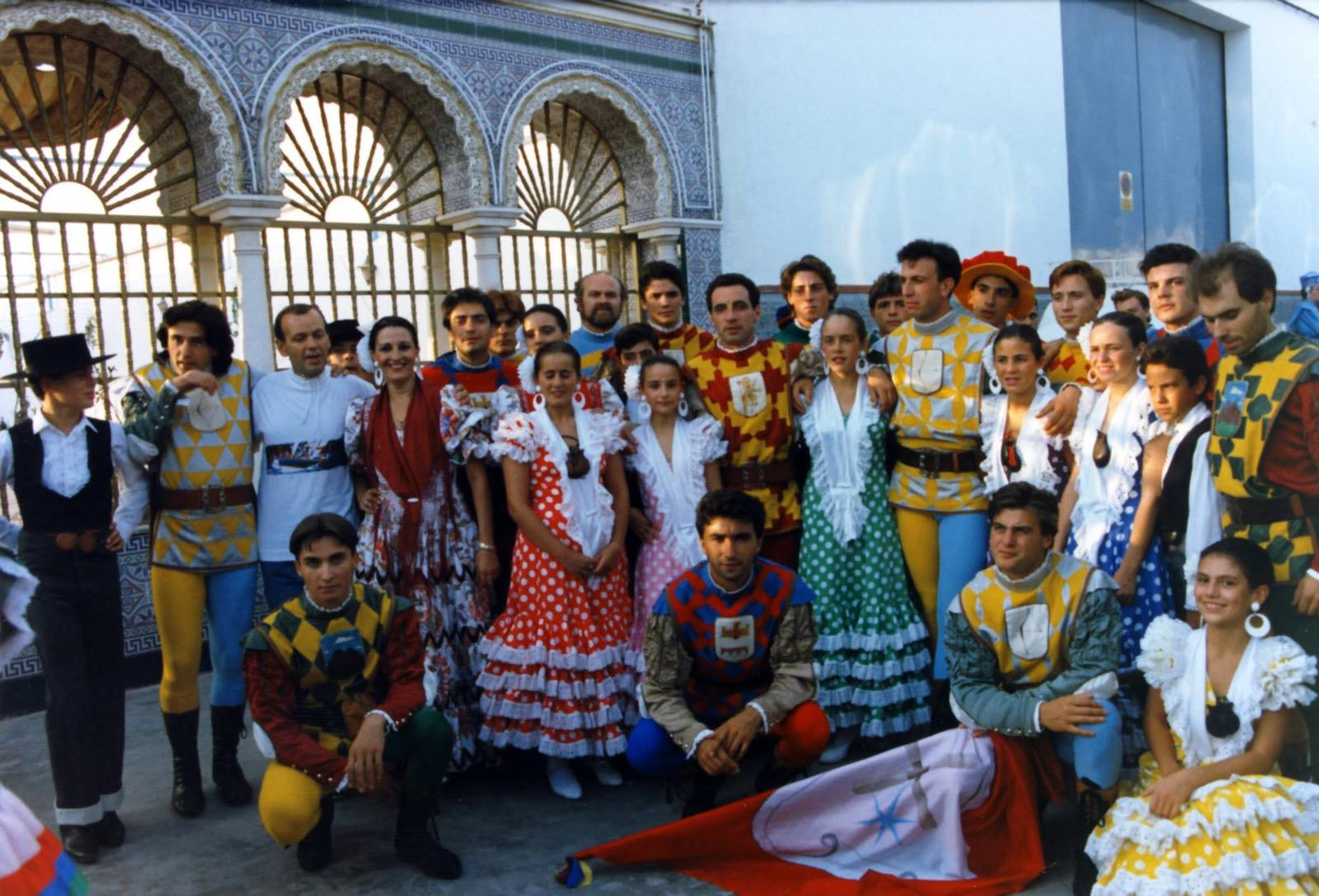
An important experience was the encounter, during the 1997 Festival, with a group from Madrid and a theatrical composition inspired by Goya. That performance provided new inspiration and helped the Group understand how much the theatrical dimension of its shows could be expanded.
Among the first women involved in this phase, Pistilli remembers Anna Maria Pasquali, Francesca De Cave, Rossella Palliccia and Anna Martelloni. Their participation as dancers represented a significant change from the previous tradition and was not without resistance and debate.
Alberto particularly emphasises the dignity and intelligence with which those women faced a period of transformation that would help redefine the Group’s future.
From Divisions to New Cultural Experiences for Cori
Between the late 1990s and the early 2000s, one of the most significant divisions in the association’s recent history took place.
According to Pistilli, it would be simplistic to attribute that division to a single cause. Different visions of performance, tradition, innovation and the future of the association were coming into conflict.
That period also led, directly or indirectly, to the development of other cultural and association-based initiatives in the town, including the Latium Festival and, as early as 1998, the Renaissance dance group Tres Lusores.
Alberto particularly remembers the dedication of Tommaso Ducci, Giulio Cucchiarelli, Orazio Fanfani and Francesca Trenta, together with others who contributed to these new experiences.
Today, more than twenty-five years later, he believes it is far more important to understand what those divisions produced in Cori’s cultural history than to establish who was right and who was wrong.
Tradition and Innovation: Preserving an Identity in Motion
For Pistilli, tradition and innovation are not opposing elements. The Group of the Rioni has always experimented and innovated: even what is now considered tradition was once the result of a new choice.
Authenticity, however, remains at the heart of the matter.
For many years, the Flag-Wavers presented what was described as a distinctive Cori school of flag-waving. The Flag Games provided important opportunities to compare their approach with other traditions, including those of Orte and Fossano.
Comparison does not necessarily mean imitation. It means getting to know one’s own identity better, improving technique and understanding which elements make a particular style recognisable.
Even today, it is possible to experiment with more dynamic, faster and more contemporary performances while preserving the distinctive features of the Group’s technical and artistic identity.
Major International Experiences: Seoul, Taiwan, Puerto Rico and Canada
International trips represent another fundamental chapter in Alberto’s memories.
Seoul, with the 1988 Olympic Games, remains a memory of an extraordinary scale, where organisational precision and stage quality reached impressive levels.
Villablanca is mainly associated with the schedules and rhythms of the events. Taiwan, on the other hand, holds a series of episodes, words and gestures that belong to the Group’s shared memories.
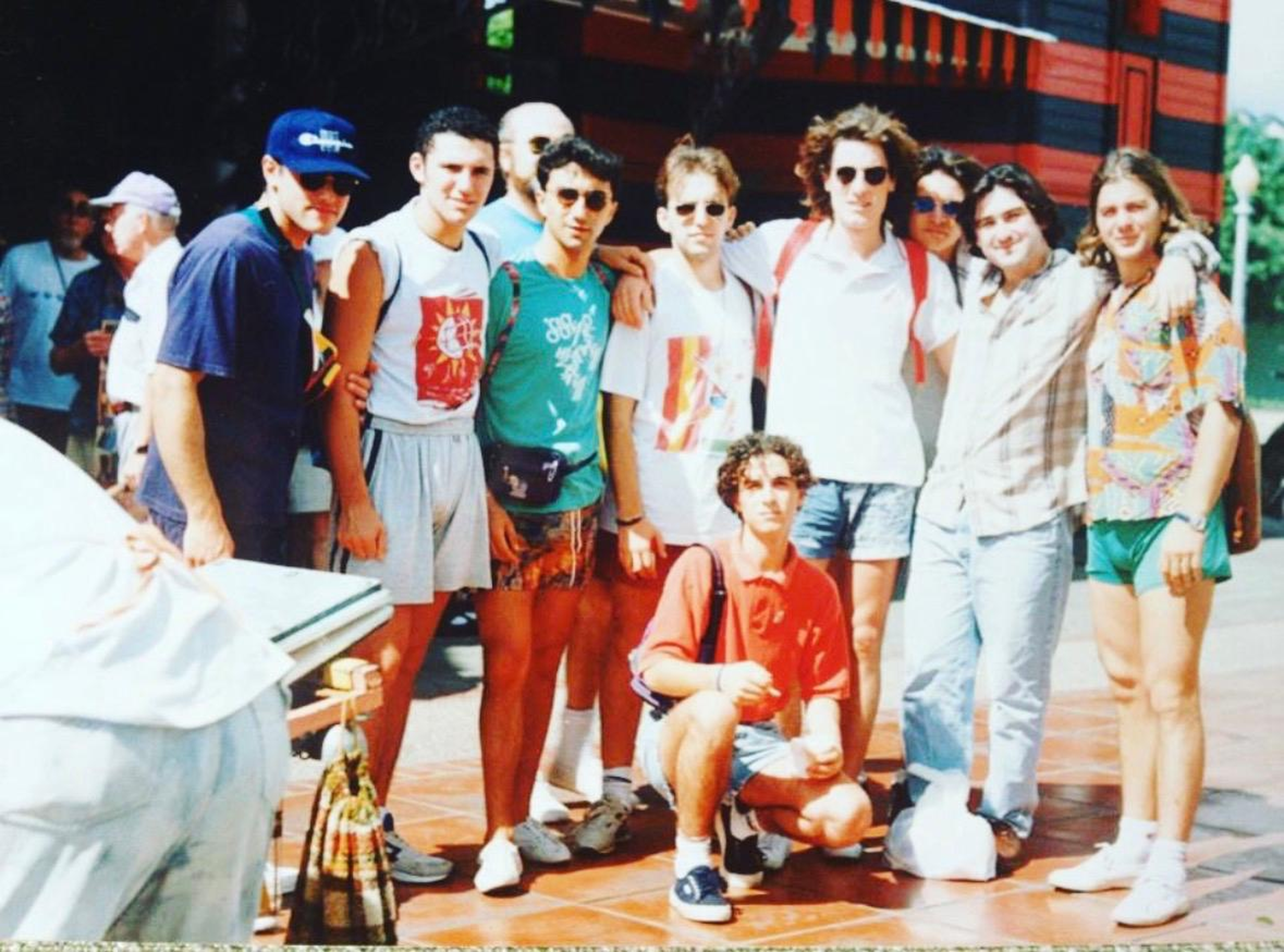
Puerto Rico brings back memories of January heat, people, theatres and encounters. Drummondville, in Canada, was probably one of the most important lessons in organisational ability and one of the most significant moments of that twenty-year period in terms of technique and stage presence.
Experiences that inevitably leave their mark on those who live them.
When a Festival Becomes a Lifelong Friendship
Among the most beautiful legacies of international experiences are the human relationships that stand the test of time.
Pistilli tells the story of a friend from Burgos whom he met in Brazil in 1997 and who has since returned to Cori at least twenty times. In the meantime, their families have grown, their children have become friends, and the bond has become so strong that his friend has even expressed the desire to buy a second home in the town.
Over the years, many people from Cori have also shared part of the Camino de Santiago with him.
For Alberto, this is one of the Festival’s deepest meanings: not simply organising performances, but building relationships that can last for decades and involve entire families.
The 60th Anniversary: An Opportunity to Rebuild Collective Memory
According to Pistilli, the 60th Anniversary represents an important opportunity to reconstruct the Group’s history and recognise the experiences of those who have lived through its different periods.
Looking back at the 50th Anniversary, Alberto believes that many wounds were still too recent to allow genuine reconciliation. Ten years later, the situation has changed: many people who experienced the association’s different periods are now retired or have more time and perhaps a greater desire to leave something to future generations.
Photographs, documents, stories, skills and memories represent a heritage that deserves to be collected and shared.
It would be important to involve those who have lived through the Group’s history, bring them together with younger members and ask them not only what happened, but above all what can be learned from those experiences.
Rebuilding Relationships Means Creating Something Together Again
For Alberto, reconciliation is not simply a handshake or a symbolic gesture of peace.
True reconciliation takes place when people who have experienced different periods come together to work again: preparing an exhibition, organising an event, training young members or digitising an archive.
A seventy-year-old working alongside a twenty-year-old inevitably passes on something that goes beyond technical skills. And the older person can learn from the younger one too.
This is the true meaning of passing the torch.
Today, the Group is experiencing another major generational transformation, characterised by a strong presence of young people and much greater female participation than in the past.
Pistilli considers this a positive development. Every generation must be able to question some aspects of the previous one, without being forced either to preserve everything unchanged or to start from scratch.
The challenge is to bring memory and transformation together.
The Future of the Group: More Bridges, Fewer Barriers
Looking ahead, Alberto imagines an association capable of mediating, bringing people together and examining even the less clear periods of its own history.
The goal should not be to reopen old disputes, but to reach the 65th or 70th Anniversary with a greater ability to reconnect with the Group’s collective memory.
He would like to see more dialogue, less forced competition and greater attention to those who risk being left behind.
One of his most meaningful reflections concerns the very idea of belonging: a group truly exists when it manages to bring along even its least strong member, not only when it celebrates its most talented one.
A Community That Goes Beyond the Flag-Wavers
According to Pistilli, the Group’s future cannot be separated from the future of the town.
The Flag-Wavers are part of a wider community in which the Carosello Storico, the Latium Festival, cultural associations, local taverns and restaurants should work together.
Alberto looks with interest at the energy young people are investing in organising local initiatives and believes it is essential to continue bringing different forces together.
What he would particularly like to preserve is the happiness visible in people’s eyes after days of work for a tavern, a Festival or the Carosello. They are tired, sometimes exhausted, yet able to express a special kind of serenity.
For him, that light demonstrates the social value of these activities.
Sustainability and Authenticity: A Vision for Cori
Alberto’s dream is to see much closer cooperation between the town’s cultural, association-based and economic organisations.
In his view, Cori should not try to compete with Rome, major art cities or mass-tourism destinations. Instead, it can highlight what makes it authentic: local products and food, encounters, education, workshops, dance, flags, the landscape and its historical and artistic heritage.
He imagines meetings, training courses and cultural experiences that can also involve young people from Cori according to their studies and the skills they are developing.
In this regard, he recalls the experience of Alessandro and Marco Cardilli, who were involved in the design and construction of a memorable stage set while they were still students. Today they are professional set designers. On that occasion, the meeting between their artistic vision and Alberto’s experience in temporary structures made an important result possible for everyone involved.
This is precisely the kind of collaboration he would like to see multiply: a communications student contributing to communication activities, a young architecture student helping with an installation, a musician working on compositions, a photographer building an archive, or an IT specialist digitising the Group’s memories.
A network of skills that could support not only associations, but also local businesses and the town’s social fabric.
Two words sum up this vision: sustainability and authenticity.
A Message to Future Generations: Understand, Change, Build
Before concluding, Alberto identifies one risk that must be avoided: short-sightedness.
Suspicion, old disagreements, rumours and personal issues should not consume all the energy of a community. Memory should help us understand, not condemn endlessly.
Instead, we need to return to the simplicity of a fundamental gesture: giving a young person a point of reference and a role, telling them, «You can take care of this», and helping them understand that their contribution is necessary.
The message he leaves to future generations is clear: do not be afraid to change the Group, because every generation has done so. But get to know it before transforming it. Talk to those who came before you, listen to different versions of the same story, take the best from everyone and do not automatically inherit the conflicts of the past.
Above all, build.
Because after the discussions, presidencies, journeys, victories and defeats, what truly remains are the people with whom we have built something.
This is Alberto Pistilli’s story. And above all, this is the wish for the next sixty years of the Flag-Wavers of the Rioni of Cori.